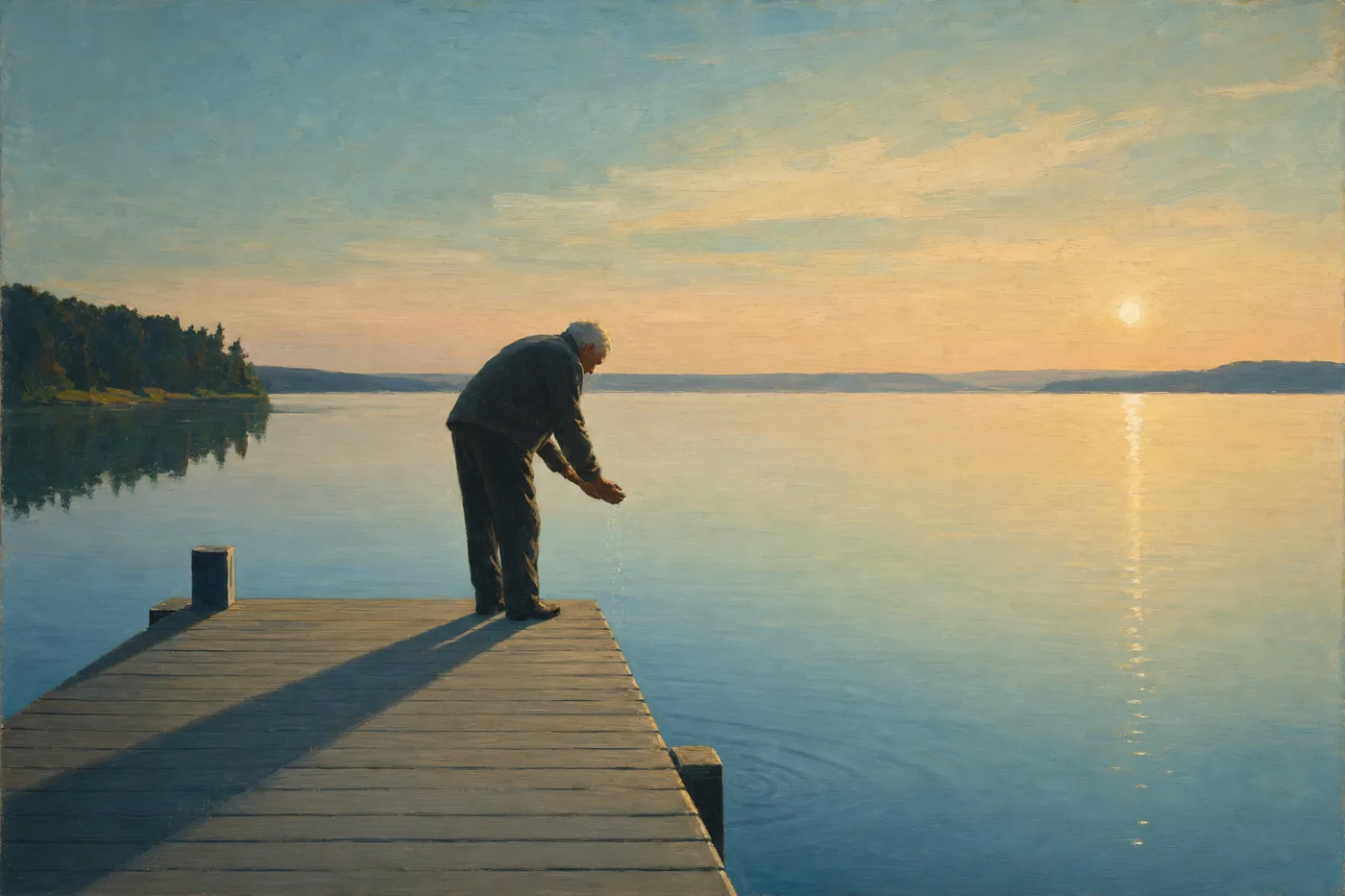
Water in James Mulhern’s work is almost never grand. It does not part or flood or drown anyone in a single dramatic stroke. It arrives instead as a tide pool by a “bony cliff,” as tears mistaken for dew on a fall afternoon, as rain tapping a windowpane while someone falls asleep, as the indignities of a body that can no longer hold its own water. It is, in other words, an element associated less with spectacle than with care in his fiction and verse.
The clearest instance of water asked to do theological work is the beach trip at the center of “Assumptions.” The family drives to Nantasket for one reason: “the cure Helen dragged everyone to Nantasket for.” Two women walk into the sea to be healed, in the plain, unexamined faith of people who have always gone to the shore when something in the body needs fixing. The story lets the reader believe, briefly, that the water is where the miracle will happen — that this is a baptism in the ordinary sense, immersion as cure. Then it quietly withdraws that promise. “The cure… does not come from the water. It comes from the Son, after death.” The sea does not fail the family so much as it clarifies what water is actually for in this world: not the site of the miracle, but the place you go while waiting for one, the ritual that dignifies the waiting.
Mulhern’s poems keep the water at a more intimate, unglamorous scale. In “Leaves,” the wet ground of a childhood chore — “smell of earth and wet decay,” a flashlight hunting the last stray leaf — returns, stanza by stanza, as the wet ground of a grave. The poem does not announce the shift. It repeats the same physical sensations, the cold air and the visible breath, until “the damp leaves shimmer like tears.” Water can be read here as memory’s medium: the thing that returns, involuntarily, disguised as weather.
In “Honeymoon,” water turns domestic and tender at once. A speaker rubs ointment into a mother’s calloused heel while “the rain outside taps a pane” and an old photograph glows on the end table. “I think of how far these feet have walked, / the tenderness at the bottom of her sole.” The rain does no plot work; it keeps time, marking the room as a place where care is being paid out in small, unglamorous installments. And in “Moving Forward,” Mulhern includes water at its least dignified: a dying dog’s “bloody urine,” the diapers that keep “falling off,” an aging mother’s failing eyes and a body “filled with metal.” The poem’s conclusion — “All of the living are broken, inside and out… it’s how we care for others… that helps us become whole again” — follows this physical, humiliating material. A related pattern appears in the fiction: care is administered by unreliable, embarrassed, exhausted people through undignified materials.
Taken together, the tide pool, the rained-on windowpane, and the incontinent old dog suggest a shared use of water in this body of work. It is not the medium of the miracle so much as the medium of tending — a substance encountered where illness, mourning, and love intersect. Water carries meaning here without much dramatic emphasis. A tear that might be dew, a tide that might be a cure, a rain that is only rain until you notice what it is falling on: this reticence shapes the technique. Unlike the fire, the water in these pages does not announce itself.